
Braces in Los Angeles
Traditional metal and ceramic braces for teens and adults — precise, reliable correction for crowding, rotations, and bite issues from Dr. Edward Nam, DDS, serving Koreatown and greater Los Angeles in English and Korean.
Metal & Ceramic Braces in Koreatown
Both systems use the same proven mechanics — brackets bonded to each tooth, connected by a thin archwire that guides teeth into position. The choice comes down to how visible you want them to be.
Traditional Metal Braces
The workhorse of orthodontics — and still the most efficient way to move teeth. Today's stainless-steel brackets are dramatically smaller and lower-profile than the ones you remember from a generation ago, and they give Dr. Nam millimeter-level control over every tooth. Metal braces handle the widest range of corrections, from mild crowding to major bite reconstruction, and they never come off track because a patient forgot to wear them.
Ceramic (Clear Bracket) Braces
Ceramic braces deliver the same precise, around-the-clock tooth movement as metal, but with tooth-colored brackets that blend into your smile — most people won't notice them from a conversation away. They're the most popular choice among our adult braces patients in Los Angeles: professionals who need serious correction that clear aligners can't reliably deliver, without a mouth full of visible metal at work.
When Braces Beat Clear Aligners
Clear aligners are excellent for mild to moderate cases — but there are tooth movements that fixed braces simply perform better. Because brackets are bonded directly to each tooth, braces can grip, rotate, and pull in ways plastic trays cannot. Dr. Nam recommends braces over aligners when your case includes:
Complex bite issues
Significant overbites, underbites, and crossbites often need the sustained, three-dimensional force control that only fixed braces provide.
Severely rotated teeth
Twisted teeth — especially rounded premolars — are notoriously hard for aligners to grip. Brackets rotate them predictably.
Severe crowding
When teeth overlap heavily, braces manage the large movements and root repositioning needed to create room and align everything correctly.
Vertical movements
Pulling a tooth down or pushing one up into the bite is a mechanical strength of braces that aligners struggle to match.
Patients who'd rather not think about it
Braces work 24/7 with zero willpower required — no trays to remember, lose, or leave in a lunchroom napkin.
What Braces Treatment Looks Like
Most comprehensive cases take 18 to 30 months from bonding day to retainers — simpler alignment can finish faster. Here is the path from start to finish.
Consultation & Digital Scan
Dr. Nam examines your teeth and bite, takes a precise digital 3D scan — no messy impressions — and maps out exactly how each tooth needs to move.
Bonding Day
Brackets are bonded to each tooth and the first archwire is placed. The appointment is painless and takes about an hour. Expect general soreness for the first few days as your teeth start moving.
Monthly Adjustments
Roughly every 4–8 weeks you come in for a short visit where Dr. Nam changes wires and fine-tunes the forces. Each adjustment nudges your teeth to the next stage of the plan.
Debonding & Retainers
Once your teeth and bite are where they should be, the brackets come off — the most satisfying appointment in dentistry — and you receive custom retainers to lock in your new smile.
More Comfortable Than You Remember
If your mental image of braces comes from the 1990s, it's out of date. Modern brackets are low-profile — smaller, smoother, and rounded so they sit closer to the tooth and irritate your cheeks and lips far less. Today's heat-activated archwires apply lighter, more continuous forces, which means teeth move steadily with less of the soreness older systems caused.
The first week takes some getting used to: expect pressure for a few days and a short adjustment period while your mouth adapts to the brackets. Orthodontic wax, soft foods, and an over-the-counter pain reliever cover almost every complaint. After that, most patients tell us they forget the braces are even there between adjustment visits.
Braces for Teens — and Adults
The teenage years remain the classic time for braces: the jaw is still growing, which lets Dr. Nam guide bite development while aligning the teeth, and fixed braces remove the compliance battles that come with removable aligners. Teens can even pick colored bands at each visit — a small thing that makes the process theirs.
But braces are not just for kids. Adult braces are one of the fastest-growing parts of our Koreatown practice — patients in their 30s, 40s, 50s and beyond who are done living with crowding, a shifting bite, or a smile they hide in photos. Healthy teeth and gums can be moved at any age, and ceramic brackets keep treatment discreet at work. Straighter teeth are also easier to clean, which pays dividends in gum health for decades. Our bilingual team serves patients comfortably in English and Korean at every visit.
What to Expect From Your Results
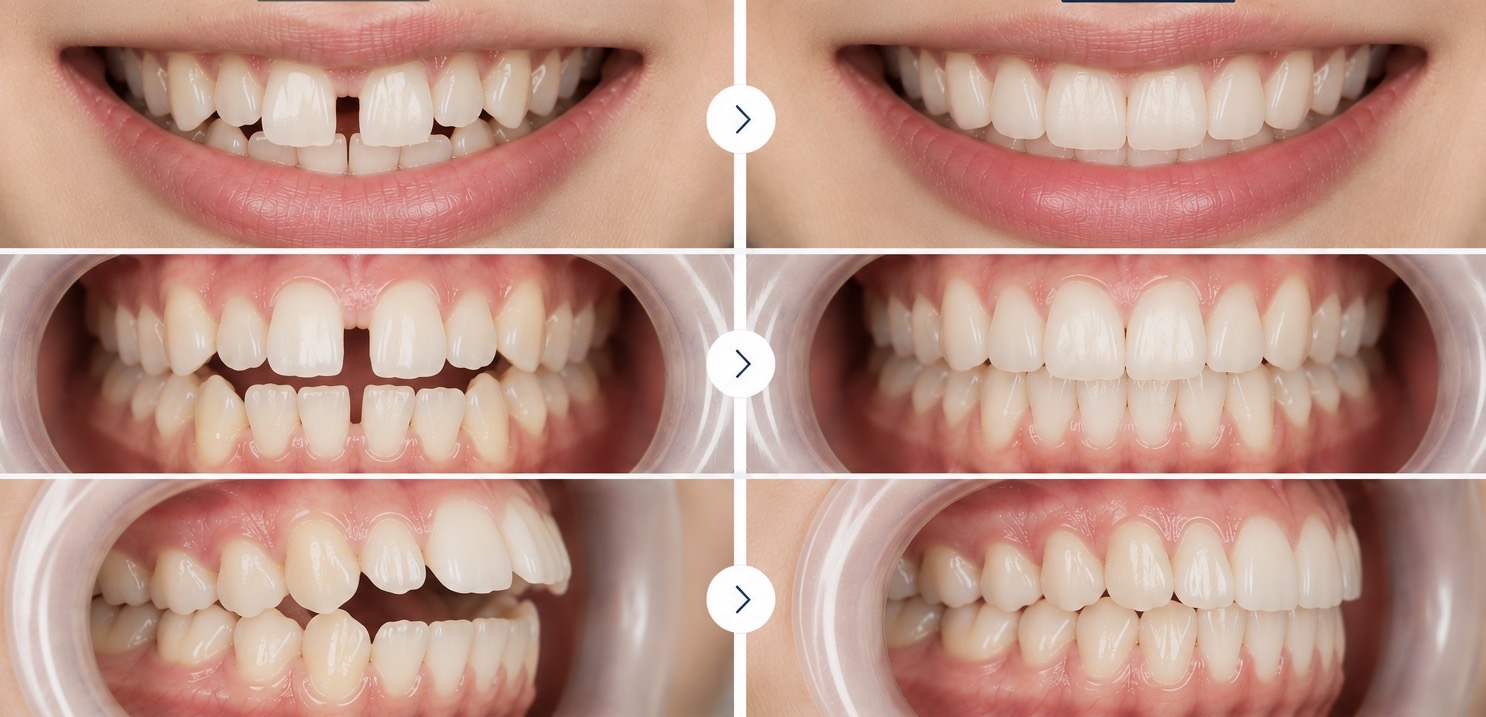
Braces don't just straighten the teeth you see when you smile — they correct how your upper and lower teeth meet, which protects against uneven wear, chipping, and jaw strain for the rest of your life. These are actual orthodontic results from our Los Angeles patients.
Braces vs. Invisalign
There is no universally "better" option — only the better option for your case. Invisalign clear aligners shine for mild to moderate crowding and spacing when discretion and removability matter most. Braces shine when the correction is bigger: complex bites, severe crowding, rotated teeth, and vertical movements — and for anyone who would rather have treatment quietly working around the clock than manage trays 22 hours a day.
Because Dr. Nam offers both systems, his recommendation is driven by your bite — not by the only tool on the shelf. Many patients arrive convinced they want one option and leave the consultation confident in the other. For a deeper side-by-side comparison, read our guide on Invisalign vs. braces for adults, then come in and let's look at your teeth together.
Retainers: Protecting Your Investment
The day your braces come off is not quite the finish line — it's the handoff. Teeth have a long memory, and without a retainer they will gradually drift back toward their old positions, a process called relapse that can undo months of treatment within a year or two. That's why retention is built into every treatment plan at our office, not offered as an afterthought.
After debonding, Dr. Nam fits you with custom retainers and gives you a simple wear schedule — typically full-time for a short initial period, then nights only. Depending on your case, that may be a clear removable retainer, a fixed wire bonded discreetly behind the front teeth, or both. Wear it as directed and the smile you worked 18 to 30 months for stays exactly where it belongs — for life.
Braces FAQs
How long do braces take?
Most comprehensive cases finish in 18 to 30 months. Simpler alignment issues can wrap up in about a year, while severe crowding or significant bite correction takes longer. Your timeline also depends on how consistently you keep adjustment visits and follow care instructions. After examining your teeth and reviewing your digital scan, Dr. Nam will give you a realistic estimate for your specific case — not a one-size-fits-all number.
Do braces hurt?
Getting braces placed doesn't hurt — bonding the brackets is completely painless. You will feel pressure and general soreness for three to five days after the initial placement and for a day or two after each adjustment, which is a normal sign your teeth are moving. Over-the-counter pain relievers, soft foods, and orthodontic wax on any spot that rubs handle it well. Today's low-profile brackets are far more comfortable than the braces of a generation ago.
Am I too old for braces?
No — healthy teeth can be moved at any age, and adult braces are more common than ever. Many of our Koreatown patients are professionals in their 30s, 40s, and beyond who finally want to fix crowding or a bite issue they've lived with for years. Adults who prefer a subtler look often choose ceramic braces, whose tooth-colored brackets blend in noticeably better than metal. Dr. Nam treats teens and adults side by side every week.
Should I choose metal or ceramic braces?
Both move teeth the same way — the difference is appearance and durability. Traditional metal braces are the strongest, most efficient option and a smart choice for teens and complex corrections. Ceramic braces use tooth-colored brackets that are much less visible, which makes them popular with adults, though the brackets are slightly more brittle and can require a bit more care. Dr. Nam will show you both options at your consultation and recommend the better fit for your bite and lifestyle.
What can't I eat with braces?
You'll want to avoid foods that can bend wires or pop brackets off: hard items like ice, nuts, and hard candy; sticky foods like caramel and gummies; and chewy crusty breads. Cut apples, carrots, and corn off the cob into bite-size pieces rather than biting in directly. Everything else — rice, noodles, soups, meats, soft breads, and most Korean and American staples — is fine. A broken bracket isn't an emergency, but it does slow your treatment down, so a little caution pays off.
How much do braces cost in Los Angeles?
There is no flat price for braces — the cost depends on how much movement your teeth need, whether you choose metal or ceramic brackets, and the total length of treatment. Rather than quote a misleading range, Dr. Nam will provide an exact quote at your free consultation after examining your teeth and taking a digital scan. We verify your insurance benefits for you and offer flexible financing so treatment fits your budget.
Ready for a straighter smile?
Free braces consultation in Koreatown — English & Korean spoken.